Time is money
May 19, 2026
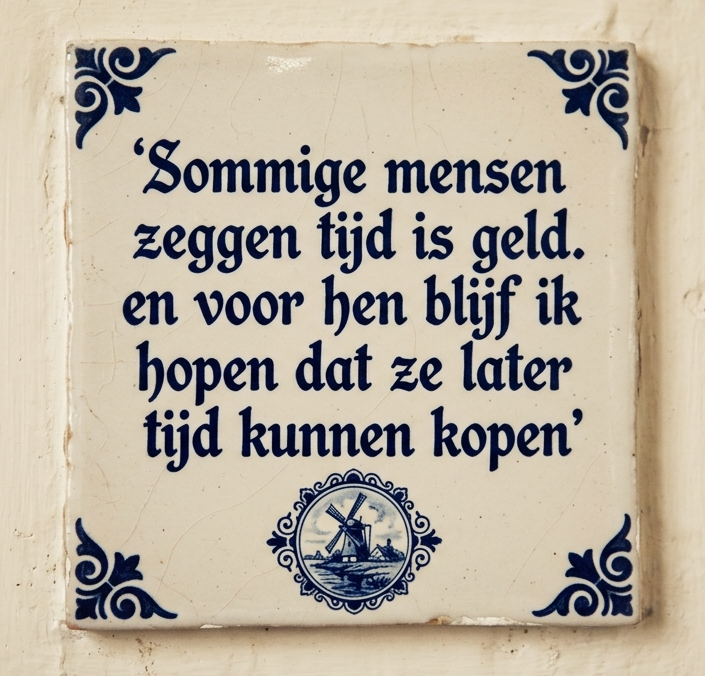
"Sommige mensen zeggen tijd is geld. En voor hen blijf ik hopen, dat ze later tijd kunnen kopen"
This Dutch quote plays on two common expressions about time and money.
First, the literal translation:
"Some people say time is money. For them, I keep hoping that later they can buy time."
Breaking it down:
- “Time is money” – This is a well-known saying, especially in work-oriented, capitalist cultures. It means time is a valuable, scarce resource that should be used productively, because wasting time is like wasting money.
- “For them, I keep hoping that later they can buy time” – This is the twist. The speaker knows you can’t actually buy more time in the literal sense (time is not a commodity you can purchase). So wishing that such people can buy time later is a gentle, ironic critique.
The deeper meaning:
The quote contrasts two worldviews:
- One group sees time purely economically: every minute has a price tag, efficiency is key, leisure is a “cost.”
- The speaker suggests that if you live that way, you will eventually reach a point (e.g., old age, a terminal illness, or simply burnout) where you’d gladly trade all your money for more time to live, rest, or be with loved ones — but by then, it’s impossible.
So the hope expressed (“I hope they can buy time later”) is sarcastic or darkly humorous. It implies: They will learn the hard way that time is infinitely more precious than money, and no amount of wealth can buy back a single moment.